
Travis Bunn
Founder, AppealDesk · Published February 13, 2026 · Updated March 8, 2026
Property Tax Assessment Ratios by State: Complete 2026 Guide
Updated March 2026 · 12 min read
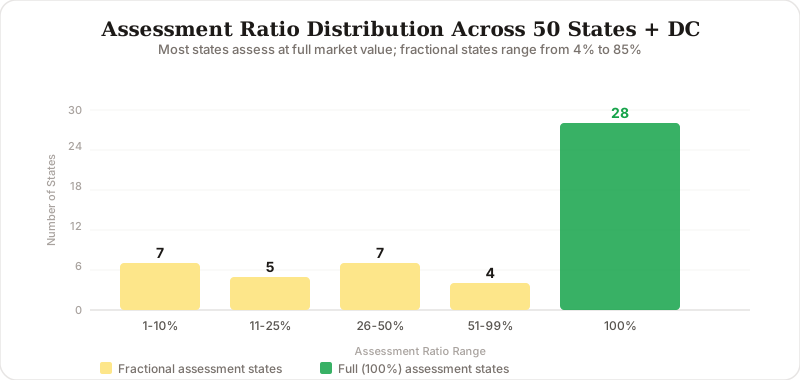
Assessment ratios range from 4% (South Carolina) to 100% (California, Texas, and 20+ other states). Understanding your state's ratio is critical for a successful property tax appeal, it determines how to correctly compare your assessed value to actual market data. This guide covers every state's statutory assessment ratio, explains how to use the ratio during an appeal, and walks through worked examples so you never make the most common DIY appeal mistake.
Key Takeaway
What Is a Property Tax Assessment Ratio?
A property tax assessment ratio (also called an assessment level, assessment percentage, or level of assessment) is the percentage of a property's fair market value that a taxing jurisdiction uses as the taxable base. The International Association of Assessing Officers (IAAO) publishes standards governing how these ratios should be applied and measured. Every state sets its own ratio by statute, and it determines how your assessed value relates to what your property is actually worth.
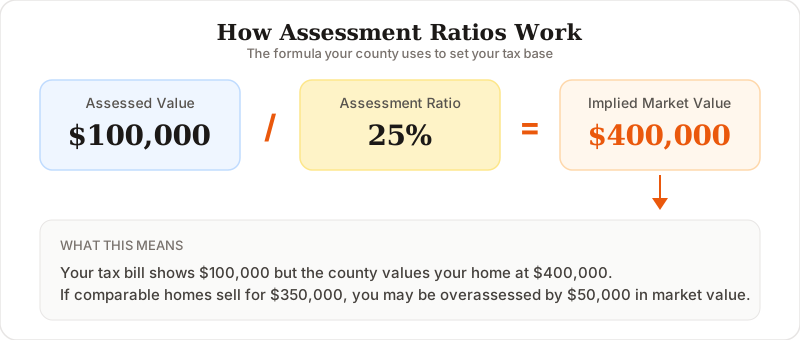
Here's the fundamental formula:
Assessed Value = Market Value × Assessment Ratio
Or, rearranged: Implied Market Value = Assessed Value ÷ Assessment Ratio
For example, if your home has a fair market value of $400,000 and you live in a state with a 25% assessment ratio, your assessed value would be $100,000. Your property taxes are then calculated on that $100,000 base , not on the full $400,000.
Why Do States Use Fractional Assessment Ratios?
Fractional assessment is largely a historical artifact. In earlier eras, state legislatures adopted lower ratios to make the numbers on tax bills appear smaller, even though tax rates (millage rates) were adjusted upward to compensate. The net tax paid is the same whether your state assesses at 10% with a high millage rate or at 100% with a low millage rate. The critical distinction is transparency: 100% assessment states make it easier for homeowners to compare their assessed value to comparable sales, while fractional states add an extra layer of math that confuses many people.
How Assessment Ratios Create Confusion During Appeals
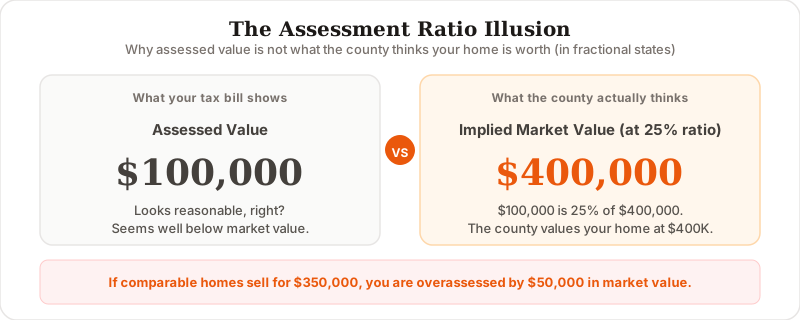
This confusion is where the biggest overassessment mistakes happen. In a fractional assessment state, your assessed value is intentionally lower than your home's market value, that's by design, not because the county is giving you a break. If you compare your assessed value directly to sale prices without accounting for the ratio, you'll reach the wrong conclusion about whether you're overassessed.
To properly evaluate your assessment, you must convert your assessed value back to an implied market value using the formula above, then compare that implied market value to comparable sales. This is the single most important concept in property tax appeals for homeowners in fractional assessment states.
Lowest Ratio
4%
South Carolina
Highest Ratio
100%
28 states
Fractional States
23
states + DC
Full Value States
28
assess at 100%
Assessment Ratios by State: Complete 2026 Table
The table below lists the statutory assessment ratio for every U.S. state plus the District of Columbia, along with the statutory source, median home value, and effective tax rate. States that assess at 100% of market value are marked with a 100% badge. States with fractional ratios are marked with an amber badge showing their ratio.
| State | Assessment Ratio | Statutory Source | Median Home Value | Effective Tax Rate |
|---|---|---|---|---|
| Alabama | 10% | Ala. Code 40-8-1 | $157,100 | 0.4% |
| Alaska | 100% | AS 29.45.060 | $318,000 | 1.04% |
| Arizona | 10% | A.R.S. 42-15003 | $326,000 | 0.62% |
| Arkansas | 20% | Ark. Code Ann. 26-26-303 | $142,000 | 0.62% |
| California | 100% | Cal. Rev. & Tax. Code 110.1; Prop 13 | $659,000 | 0.71% |
| Colorado | 6.25% | C.R.S. 39-1-104.2 | $472,000 | 0.51% |
| Connecticut | 70% | Conn. Gen. Stat. 12-62a | $311,000 | 2.15% |
| Delaware | 100% | Del. Code tit. 9, ch. 83 | $299,000 | 0.53% |
| District of Columbia | 100% | D.C. Code 47-820 | $635,000 | 0.56% |
| Florida | 100% | Fla. Stat. 193.011 | $338,000 | 0.86% |
| Georgia | 40% | O.C.G.A. 48-5-7 | $249,000 | 0.9% |
| Hawaii | 100% | HRS 246 | $739,000 | 0.28% |
| Idaho | 100% | Idaho Code 63-205 | $334,000 | 0.63% |
| Illinois | 33.33% | 35 ILCS 200/9-145; Cook County Classification Ordinance | $239,000 | 2.07% |
| Indiana | 100% | IC 6-1.1-31 | $182,000 | 0.85% |
| Iowa | 100% | Iowa Code 441.21 | $165,000 | 1.52% |
| Kansas | 11.5% | K.S.A. 79-1439 | $175,000 | 1.33% |
| Kentucky | 100% | KRS 132.190 | $155,000 | 0.86% |
| Louisiana | 10% | La. Const. Art. VII 18(B) | $174,000 | 0.55% |
| Maine | 100% | 36 M.R.S.A. 701-A | $253,000 | 1.24% |
| Maryland | 100% | Md. Code Ann., Tax-Prop. 8-104 | $380,000 | 1.07% |
| Massachusetts | 100% | M.G.L. c. 59, 38 | $466,000 | 1.12% |
| Michigan | 50% | MCL 211.27a | $201,000 | 1.38% |
| Minnesota | 100% | Minn. Stat. 273.11 | $275,000 | 1.02% |
| Mississippi | 10% | Miss. Code Ann. 27-35-50 | $130,000 | 0.81% |
| Missouri | 19% | Mo. Rev. Stat. 137.115 | $182,000 | 0.93% |
| Montana | 100% | MCA 15-8-111 | $330,000 | 0.74% |
| Nebraska | 100% | Neb. Rev. Stat. 77-112 | $190,000 | 1.61% |
| Nevada | 35% | NRS 361.227 | $367,000 | 0.55% |
| New Hampshire | 100% | RSA 75:1 | $339,000 | 2.09% |
| New Jersey | 100% | N.J.S.A. 54:4-2.25 | $395,000 | 2.23% |
| New Mexico | 33.33% | NMSA 7-36-21 | $213,000 | 0.67% |
| New York | 100% | RPTL 305; RPTL 524 | $370,000 | 1.62% |
| North Carolina | 100% | N.C.G.S. 105-283 | $256,000 | 0.82% |
| North Dakota | 50% | N.D.C.C. 57-02-01 | $209,000 | 0.98% |
| Ohio | 35% | ORC 5713.03; 5715.01 | $173,000 | 1.53% |
| Oklahoma | 11% | 68 O.S. 2817 | $153,000 | 0.87% |
| Oregon | 100% | ORS 308.232; Measure 50 (1997) | $397,000 | 0.87% |
| Pennsylvania | 100% | 72 P.S. 5020-402; PA DoR Common Level Ratio factor list (annual) | $220,000 | 1.53% |
| Rhode Island | 100% | R.I. Gen. Laws 44-5-12 | $343,000 | 1.4% |
| South Carolina | 4% | S.C. Code Ann. 12-43-220(c) | $208,000 | 0.57% |
| South Dakota | 85% | SDCL 10-6-33 | $214,000 | 1.17% |
| Tennessee | 25% | Tenn. Code Ann. 67-5-801 | $230,000 | 0.67% |
| Texas | 100% | Tex. Tax Code 23.01 | $238,000 | 1.6% |
| Utah | 55% | Utah Code 59-2-103 | $408,000 | 0.52% |
| Vermont | 100% | 32 V.S.A. 3481 | $272,000 | 1.83% |
| Virginia | 100% | Va. Code 58.1-3201 | $339,000 | 0.8% |
| Washington | 100% | RCW 84.40.030 | $476,000 | 0.84% |
| West Virginia | 60% | W. Va. Code 11-3-1 | $128,000 | 0.57% |
| Wisconsin | 100% | Wis. Stat. 70.32 | $228,000 | 1.61% |
| Wyoming | 9.5% | Wyo. Stat. 39-13-103(b)(ii) | $249,000 | 0.56% |
Sources: State statutes (cited in Statutory Source column), U.S. Census Bureau ACS median home values (2024–2025 vintage), Tax Foundation and Census Bureau effective rate estimates. Ratios shown are for residential (owner-occupied) property; some states use different ratios for commercial, industrial, or agricultural property.
Want to check your numbers? Use our property tax savings calculator to calculate your implied market value and estimated savings automatically , no address required, just your assessed value and home estimate.
Check Your Implied Market Value
Enter your state and assessed value to see what the county thinks your home is worth.
Popular County Appeal Guides
Harris County TX · Cook County IL · Los Angeles County CA · Maricopa County AZ · King County WA · Dallas County TX · Clark County NV · Tarrant County TX · Bexar County TX · Travis County TX · Fulton County GA · Orange County FL · Miami-Dade County FL · San Diego County CA · Collin County TX · Williamson County TX · Davidson County TN · Cuyahoga County OH · Franklin County OH · DuPage County IL
Want to Check Your Numbers?
Enter your address to see how your assessment compares to recent sales in your area.
Why Assessment Ratios Matter for Property Tax Appeals
If you're preparing to appeal your property taxes, understanding your state's assessment ratio is not optional, it's the foundation of your entire case. Here's why:
The #1 DIY Appeal Mistake
The most common mistake homeowners make when appealing on their own is comparing their assessed value directly to comparable sale prices in a state that does not assess at 100%. This error leads to one of two outcomes: either you think you're not overassessed when you actually are (because your assessed value looks “low” compared to sale prices), or you present a fundamentally flawed argument to the appeals board that undermines your credibility.
In either case, the fix is simple: always convert your assessed value to an implied market value before comparing to comparable sales. Let's walk through some real-world examples.
Worked Example: Tennessee (25% Assessment Ratio)
Your property: Assessed value of $100,000 in Tennessee, which uses a 25% assessment ratio for residential property.
Step 1, Calculate implied market value:
$100,000 ÷ 0.25 = $400,000 implied market value
This means the county believes your home is worth $400,000. The $100,000 on your tax bill is 25% of that figure.
Step 2, Compare to comparable sales: You find three comparable homes in your neighborhood that sold recently for $340,000, $355,000, and $360,000. The average is $351,667, which we can round to approximately $350,000.
Step 3, Calculate overassessment: The county says $400,000; comps say $350,000. You're overassessed by $50,000 in market value.
Step 4, Calculate your proposed assessed value:
$350,000 × 0.25 = $87,500 proposed assessed value
You would request that your assessed value be reduced from $100,000 to $87,500, a $12,500 reduction in assessed value that reflects the $50,000 market value correction.
Worked Example: South Carolina (4% Assessment Ratio)
South Carolina has the lowest residential assessment ratio in the country at just 4%. This makes the math even more critical.
Your property: Assessed value of $12,000.
Implied market value:
$12,000 ÷ 0.04 = $300,000 implied market value
A homeowner unfamiliar with assessment ratios might see “$12,000” on their tax bill and assume the county thinks their home is worth $12,000, making it seem like a great deal. In reality, the county has valued the home at $300,000.
If comps show $260,000: You're overassessed by $40,000 in market value. Your proposed assessed value should be:
$260,000 × 0.04 = $10,400 proposed assessed value
That $1,600 reduction in assessed value ($12,000 − $10,400) may look small, but it represents a $40,000 correction in market value. At South Carolina's effective tax rates, even small assessed value changes translate to meaningful annual savings.
Worked Example: New York (Variable Ratios by Municipality)
New York is uniquely complex because its Level of Assessment (LOA) varies by municipality rather than being set statewide. One town might assess at 5% of market value while the neighboring town assesses at 95%.
Your property: Assessed value of $25,000 in a town with a 10% LOA (Level of Assessment).
Implied market value:
$25,000 ÷ 0.10 = $250,000 implied market value
If comps show $210,000: You would request a reduction to:
$210,000 × 0.10 = $21,000 proposed assessed value
In New York, you can find your municipality's LOA on the NYS Department of Taxation and Finance website. Because these ratios change annually, always use the current year's published LOA when preparing your grievance (New York's term for an appeal).
States with Unusual Assessment Systems
While most states use a straightforward percentage of market value, several states have assessment systems with important wrinkles that homeowners should understand before filing an appeal.
California: Proposition 13 (Acquisition Value System)
California nominally assesses at 100% of market value, but Proposition 13 (passed in 1978) fundamentally changes how that value is determined. Instead of reassessing to current market value each year, California sets your base year value at the purchase price and limits annual increases to 2%, regardless of how much the market has appreciated.
This means a home purchased in 2000 for $300,000 might have a 2026 assessed value of approximately $500,000 (after 26 years of 2% annual increases), even if its current market value is $1,200,000. The effective assessment ratio for that homeowner is closer to 42% of current market value, even though the state officially assesses at “100%.”
For California appeals, the relevant question is not whether your home is assessed above your purchase price plus 2% annual growth, it's whether your home's current assessed value exceeds its current market value. If property values have declined since your purchase (or since a recent reassessment event), you may have grounds for a Proposition 8 temporary reduction. See the California appeals guide for details. For a deeper dive into Prop 13 mechanics, Prop 8 decline-in-value claims, and Prop 19 base year transfers, see our California Prop 13 appeal guide.
New York: Level of Assessment Varies by Municipality
As mentioned in the worked example above, New York does not have a single statewide assessment ratio. Each city, town, or village sets its own Level of Assessment (LOA), which can range from under 1% to 100%. The NYS Office of Real Property Tax Services publishes equalization rates annually that indicate the ratio of total assessed value to total market value for each municipality.
When appealing in New York, you must use your specific municipality's equalization rate, not a statewide number. Two homes with identical market values in adjacent towns can have vastly different assessed values, and both can be correctly assessed. The process is called “grieving” your assessment, and deadlines vary by jurisdiction.
Illinois: Classification-Based Ratios (Cook County)
Illinois uses a 33.33% assessment ratio statewide, but Cook County (Chicago) applies a classification system with different ratios for different property types. Residential property in Cook County is assessed at 10% of market value, while commercial and industrial properties are assessed at 25%. This means the same building could have dramatically different assessed values depending on its classification.
If you live in Cook County, use the 10% residential ratio when analyzing your assessment, not the 33.33% statewide figure. Outside Cook County, the standard 33.33% ratio applies to residential property.
West Virginia: 60% Ratio with Inconsistent Application
West Virginia's constitution requires property to be assessed at 60% of fair market value. However, the actual application of this ratio has historically been inconsistent across the state's 55 counties. Some counties maintain assessments closer to 60% of current market value, while others may lag significantly behind, creating effective ratios well below the statutory 60%.
For West Virginia appeals, compare your assessed value to 60% of your evidence of market value. If your assessed value exceeds 60% of what comparable sales indicate your home is worth, you have a strong case for reduction.
Minnesota: Limited Market Value Phase-In
Minnesota assesses at 100% of market value but applies a “limited market value” provision that caps how quickly your assessed value can increase in a single year. This means rapidly appreciating properties may be temporarily assessed below full market value as the assessment catches up over multiple years. Once the limited market value equals actual market value, the standard 100% ratio applies fully.
Skip the Math
Enter your address and we'll calculate your implied market value, find comparable sales, and build your evidence packet automatically.
100% Assessment States vs. Fractional Assessment States
From an appeal standpoint, the distinction between 100% assessment states and fractional assessment states is one of complexity, not tax burden. A state's assessment ratio does not determine how much you pay in property taxes, the effective tax rate does.
Advantages of 100% Assessment States (for Homeowners)
- Direct comparison: Your assessed value equals what the county thinks your home is worth. If your assessment says $400,000, you just need to prove your home is worth less than $400,000.
- Simpler evidence presentation: You can present comparable sales data directly without conversion math.
- Less room for error: No risk of comparing assessed value to sale prices without adjustment.
- Easier for hearing boards: Board members can follow your argument without ratio calculations.
Texas is the largest 100% assessment state and has its own unique protest process. See our Texas property tax protest guide for state-specific details including Form 50-132, ARB hearings, and county-by-county filing information.
Challenges of Fractional Assessment States
- Extra math required: You must convert assessed values to implied market values before any comparison.
- Confusion risk: Many homeowners (and some newer board members) conflate assessed value with market value.
- Small numbers mislead: In South Carolina (4%), a home worth $300,000 is assessed at $12,000, a number that feels “low” and discourages appeals.
- Different ratios for property types: Some fractional states (like Illinois) apply different ratios to residential vs. commercial property, adding another layer of complexity.
How to Use Your Assessment Ratio in a Property Tax Appeal
Whether you live in a 100% state or a 4% state, the appeal process follows the same logical steps. Here's the framework, with the assessment ratio built in at every stage.
Find Your State's Assessment Ratio
Use the table above or check your assessment notice. The ratio is usually printed on the notice itself or available on your county assessor's website. If you live in New York, look up your municipality's specific equalization rate on the NYS ORPTS website.
Calculate Your Implied Market Value
Divide your assessed value by the assessment ratio (as a decimal). In a 100% state, this step is unnecessary, your assessed value already equals the county's opinion of market value. In a fractional state, this is the most important step. For example: $50,000 assessed value ÷ 0.20 (20% ratio) = $250,000 implied market value.
Compare to Comparable Sales
Find 3–5 recent sales of similar properties in your area. Compare the sale prices to your implied market value (from Step 2), not to your assessed value. If comparable sales consistently show lower prices, you have evidence of overassessment.
Calculate Your Proposed Assessed Value
Multiply the market value supported by your comparable sales by the assessment ratio to get your proposed assessed value. This is the number you'll request on your appeal filing. For example: if comps support a $220,000 market value in a 20% ratio state, your proposed assessed value is $220,000 × 0.20 = $44,000.
File Before the Deadline
Every state has strict appeal deadlines. Miss yours and you'll have to wait until the next assessment cycle, potentially paying too much for another full year. Most deadlines fall between March and September, though some states have rolling deadlines tied to when you receive your assessment notice.
If this process feels overwhelming, you're not alone. AppealDesk’s $49 flat-fee property tax appeal evidence packets handle the ratio calculations, comparable sales research, and evidence generation automatically for all 50 states, so you get a professionally prepared appeal without doing the math yourself.
Assessment Ratios by Region: What to Know
Southern States: Wide Range of Ratios
The South has the widest variety of assessment ratios in the country. South Carolina sits at the extreme low end with a 4% residential ratio, while Florida and Georgia assess at 100% and 40% respectively. Alabama uses a 10% ratio, Mississippi uses 10–15% (depending on property class), and Tennessee uses 25% for residential property. These low ratios make the conversion to implied market value especially important for Southern homeowners preparing appeals.
Northeast: Complex Systems, High Stakes
Northeastern states tend to have higher effective tax rates, which means assessment errors cost more in real dollars. New Jersey, Connecticut, and New Hampshire all assess at 100%, making the appeal math straightforward but the stakes high. New York's variable municipal ratios add complexity, and Pennsylvania has some of the most outdated assessments in the country, with some counties using base year values from decades ago.
Midwest: Moderate Ratios, High Tax Rates
Many Midwestern states use fractional ratios in the 15–35% range. Ohio uses 35%, Indiana uses approximately 100% (with deductions rather than fractional assessment), and Illinois uses 33.33% (with Cook County's 10% exception). Combined with relatively high tax rates, Midwestern homeowners often have the most to gain from appeals but must be careful with ratio conversions.
West: Mostly 100% Assessment States
Western states predominantly assess at 100% of market value, including California, Oregon, Washington, Idaho, Montana, and Arizona. The main exception is Colorado, which uses a residential ratio that is adjusted periodically (currently around 6.7%). California's Proposition 13 system makes it an outlier even among 100% states, as explained above. For most Western homeowners, the appeal process is more straightforward because assessed value directly reflects the county's market value opinion.
Assessment Ratio vs. Effective Tax Rate: Don't Confuse Them
Homeowners often confuse the assessment ratio with the effective tax rate. They measure different things:
Assessment Ratio
The percentage of market value used as the tax base. Set by state statute. Determines the number on your tax bill's “assessed value” line. Does NOT directly determine how much you pay.
Effective Tax Rate
The actual percentage of your home's market value that you pay in property taxes annually. Calculated as: Annual Tax ÷ Market Value. This is the number that determines your real tax burden.
Consider this comparison: Alabama has a 10% assessment ratio and a 0.4% effective tax rate. California has a 100% assessment ratio but (approximately) a 0.71% effective tax rate. Alabama's assessed values look lower on paper, but Californians actually pay a more similar effective rate than the 10x difference in assessment ratios would suggest. The tax rate (millage) compensates for the assessment ratio.
When evaluating whether to appeal, focus on whether your implied market value exceeds what your property would actually sell for, not on whether your assessment ratio seems “high” or “low.” Every dollar of overassessment costs you real money, regardless of the ratio used to calculate it.
Ready to Appeal?
AppealDesk handles assessment ratio conversions, comparable sales research, and evidence preparation for all 50 states. $49 flat fee.
Start your Texas appeal: Harris County · Dallas County · Travis County · Bexar County · Tarrant County · Collin County · Denton County · Fort Bend County · Williamson County · Montgomery County
Start your California appeal: Los Angeles County · San Diego County · Orange County · Santa Clara County
Start your Illinois appeal: Cook County · DuPage County · Lake County · Will County
Start your Florida appeal: Miami-Dade County · Broward County · Orange County · Hillsborough County
Start your New York appeal: Kings County · Queens County · Suffolk County · Nassau County
Frequently Asked Questions
What is a property tax assessment ratio?
Why do some states assess at less than 100% of market value?
How do I calculate my implied market value from my assessed value?
Does a higher assessment ratio mean higher property taxes?
What is the most common assessment ratio mistake during an appeal?
Do assessment ratios ever change?
How do I find my county's actual assessment ratio?
Can AppealDesk handle assessment ratio calculations for me?
What is the difference between assessed value and appraised value?
Do commercial properties use the same assessment ratio as residential?
Now that you understand your state's assessment ratio, use our savings calculator to check if your assessment is too high, then follow our appeal checklist to prepare your case.
Data sources: Individual state statutes (cited in table), U.S. Census Bureau American Community Survey (median home values, 2024–2025 vintage), Tax Foundation (effective tax rate estimates), IAAO Standard on Ratio Studies, Lincoln Institute of Land Policy Significant Features database. Assessment ratios shown are for residential owner-occupied property. Some states apply different ratios to commercial, industrial, agricultural, or personal property. Last verified March 2026.