
Travis Bunn
Founder, AppealDesk · Published July 20, 2026 · Updated September 5, 2026
Is Ownwell Legit? The Facts Behind the Scam Accusations
Updated September 5, 2026
Yes, Ownwell is a legitimate company: an Austin-based, BBB-accredited property tax appeal service. Its BBB profile was accredited with an A+ business rating when checked September 5, 2026. That public record does not resolve every customer complaint or guarantee your result. Check the agreement and recent reviews before deciding whether you want representation or evidence you file yourself.
Full disclosure: I’m Travis Bunn, founder of AppealDesk, which competes with Ownwell. The facts below come from public records (BBB, review platforms, and Ownwell’s own published terms), checked on September 5, 2026. If you spot an error, email hello@appealdesk.com and I’ll correct it.
For customer experiences, read our platform-by-platform review guide. To evaluate your quote, use the Ownwell fee examples. Ready to choose a service? See Ownwell versus AppealDesk: who does the filing? Or start with your free property check.
The Company Facts You Can Verify Yourself
When someone asks whether a company is legit, they are really asking: is this a real business that does what it says? Here is Ownwell’s paper trail:
| Claim | What the Record Shows |
|---|---|
| Public business record | BBB lists an Austin address and accreditation since March 4, 2022. Its A+ letter grade on September 5, 2026 is a business rating, not a customer review average. |
| Published service | Ownwell describes representation in property tax appeals. Confirm the scope, property eligibility and filing year in your agreement. |
| Reported results | Ownwell reports that 88% of customers received a reduction on at least one appeal in 2025. Separately, its $774 average includes only customers who saved on at least one property that year. Both are reported as of December 31, 2025; neither predicts your result. |
| Coverage limits | Its current FAQ lists appeals in 9 states: TX, CA, FL, GA, IL, NY, WA, CO and PA. Confirm coverage for the exact address. |
| Real pricing | A contingency fee that varies by region; the example on their own pricing page uses 25% of first-year savings. No tax savings, no fee. |
Check the BBB business profile, Ownwell’s outcome figures and footnotes and service FAQ. Accreditation is not a guarantee about an individual transaction, and we have not audited Ownwell’s case files.
So Why Do People Call It a Scam?
The word appears in customer reviews, but the headline alone does not establish fraud. Public complaints include billing, cancellation, communication and dissatisfaction with appeal work or results. Separate the allegation from what the agreement and records show:
- Future enrollment. Ownwell’s help center says it monitors and appeals for future savings opportunities unless Auto-Appeal is deactivated.
- Current work and cancellation. Turning off future Auto-Appeal leaves an active appeal in place. Confirm the effective date, any current-case cancellation deadline and charges already earned.
- Evidence and invoice disputes. Ask for the filing record, result notice and fee calculation. A review is an account of that customer’s experience, not a substitute for those records.
Read the BBB complaints and responses and Trustpilot accounts directly. Ownwell disputes some allegations. We cannot decide those cases from the public reviews alone or dismiss every complaint as a misunderstanding.
The 1-Star Reviews, In Their Own Words
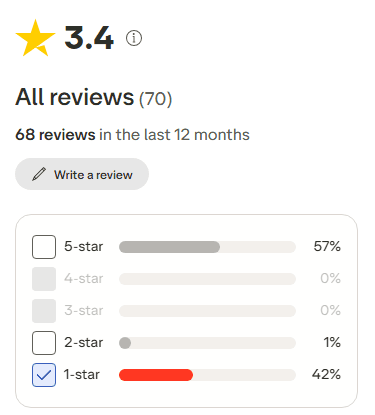
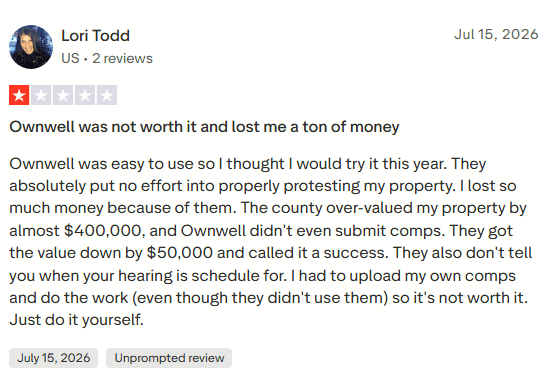
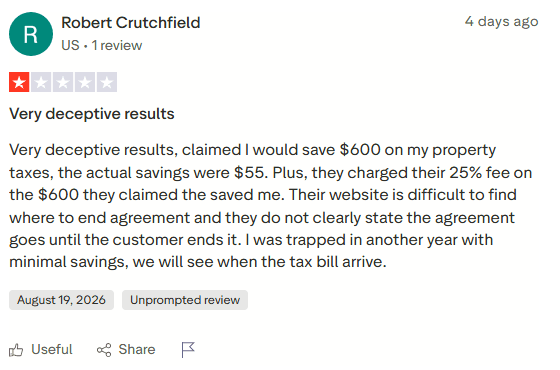
In our August 25, 2026 capture, 42 percent of the 70 reviews on Ownwell's Trustpilot profile were 1 star. These historical screenshots preserve what reviewers wrote then, not the profile’s current score. Read the live profile for new reviews and company responses:
AppealDesk’s profile, captured on the same date:
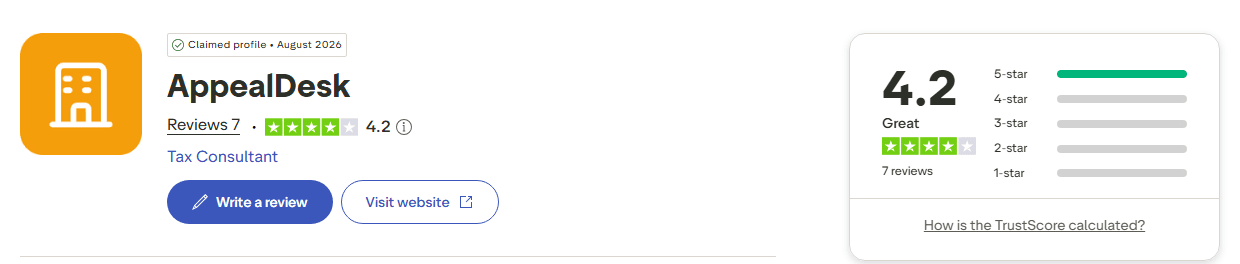
Screenshots of the live Trustpilot profiles, captured August 25, 2026. Reviews change over time, so check both profiles directly.
Prefer No Surprises? Start With the Free Check
Enter your address for a free overassessment analysis. If an appeal makes sense, it is $49 flat, one time, nothing renews, and you keep 100% of the savings.
What Ownwell Actually Does for the Fee
For an eligible full-service property, Ownwell researches comparable sales, builds the case, files the appeal with your county, and attends the informal and formal hearings on your behalf. Its fee depends on actual tax savings, not the dollar reduction in assessed value alone. You still supply the requested property information. For homeowners who would otherwise never appeal at all, that trade can be rational. We walk through exactly when in Is Ownwell Worth It?
Is Representation Worth the Fee for You?
The next decision concerns scope and cost. On their own reported average savings of $774, a fee at their 25% example rate is about $194. A flat-fee evidence service costs $49 at any savings level. The bigger your likely reduction, the more the contingency model costs you in absolute dollars. The full break-even math, with tables, is in our Ownwell pricing review. And if you want to see how the customer base actually rates the experience, platform by platform, see Ownwell Reviews: What Trustpilot, BBB & Reddit Actually Say.
Before You Sign With Ownwell (or Anyone): A 5-Point Checklist
- Get your fee percentage in writing. Ownwell’s rate varies by region, so your quote depends on location and property.
- Find the renewal clause. Check future enrollment and the separate deadline for canceling any current appeal.
- Ask what evidence you will receive. Complaints often start when customers cannot see what was argued on their behalf.
- Confirm how cancellation works, in writing with an effective date, before you need it.
- Compare responsibilities. Review the evidence, your quoted fee, and whether you want someone to file and handle hearings for you.
Choose the Service That Fits the Work You Want Handled
Ownwell has a verifiable business record, and the individual complaints still deserve to be read on their merits. If you are weighing the contingency model against a flat fee, the AppealDesk vs Ownwell comparison and the broader list of Ownwell alternatives lay out the options side by side. AppealDesk’s $49 packet provides evidence and filing guidance; you submit the appeal and handle any hearing. Fee comparisons assume the same hypothetical savings and do not predict which route would achieve a better result.
Run Your Numbers in 30 Seconds
Free overassessment check, then a $49 flat-fee evidence packet if an appeal makes sense. No contingency fee, no auto-renewal, no surprises.