Best Property Tax Protest and Appeal Companies in 2026 (Compared)
Last updated: August 13, 2026
Property tax protest companies and property tax appeal services are the same thing under two names. Texas calls it a protest, New York calls it a grievance, and most other states call it an appeal, so if you searched for the best property tax protest companies and landed here, this is the right comparison. What actually separates these companies is how they charge you. Flat-fee services like AppealDesk charge one fixed price, $49, for a professional evidence packet with comparable sales analysis, assessment ratio verification, and a county-specific filing guide. You keep 100% of whatever reduction you win, and the trade-off is that you file it yourself, which usually takes 10 to 15 minutes. Contingency companies take a cut of your savings instead. That cut is the single biggest cost difference in this market and it is wider than most homeowners expect: O'Connor's own program page says clients pay half of their first year savings, Texas Protax and NTPTS publish 40%, and Ownwell says its rate varies by region rather than quoting one national number. On a $3,000 annual reduction, 40% is about $1,200 and half is about $1,500. Contingency has a real advantage worth naming, though, which is that you pay nothing if they fail and you do no work at all. Regional firms like Texas Protax and NTPTS trade geography for depth, covering a handful of Texas counties with former appraisal district staff on the team. Every fee and coverage figure below was checked against each company's own website in August 2026, not against secondhand roundups, and anything a company does not publish is left out rather than guessed at. Here is how the major property tax protest and appeal companies compare on price, coverage, and what you actually get.
 Travis Bunn·Updated August 13, 2026
The Trustpilot pages, side by side
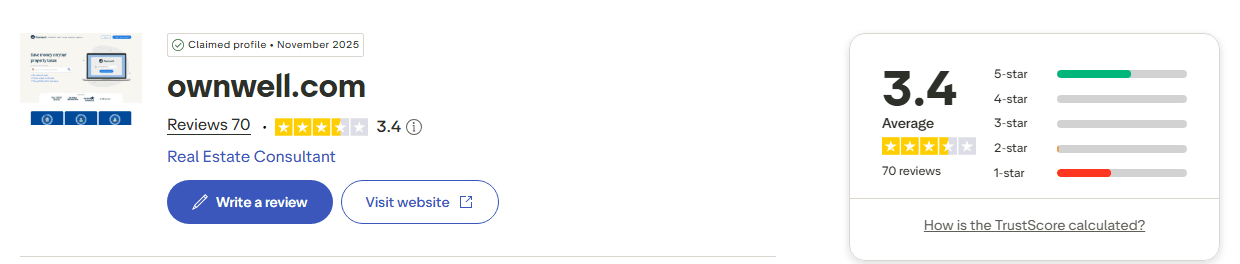
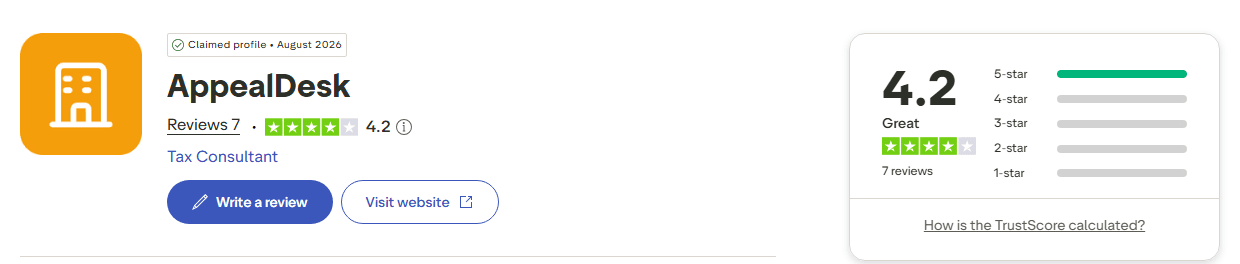
Screenshots of the live Trustpilot profiles, captured August 25, 2026. Reviews change over time, so check both profiles directly.
What the 1-Star Reviews Actually Say
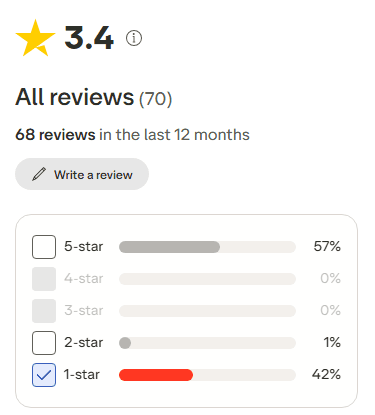
At our September 5, 2026 check, Ownwell showed 3.3 from 73 reviews on Trustpilot. These August 25 screenshots preserve an earlier profile with 70 reviews, 42 percent of them 1 star. They are historical examples, not a representative sample of today's reviews. Read the current reviews and company responses: See every review on the live profile.
AppealDesk reviews captured August 25, 2026. Read its live profile for the current record:

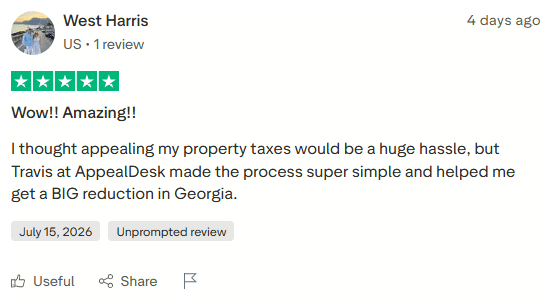
August 25, 2026 capture: AppealDesk showed 4.2 from 7 reviews, all 5 stars. Check the live profile for current ratings. view the live profile
Historical review screenshots from Trustpilot, captured August 25, 2026. Reviews change over time, so check both profiles directly.
Customers, In Their Own Words
As of August 2026, 42 percent of the 70 reviews on the Trustpilot profile for Ownwell are 1 star. See the live profile.
★☆☆☆☆
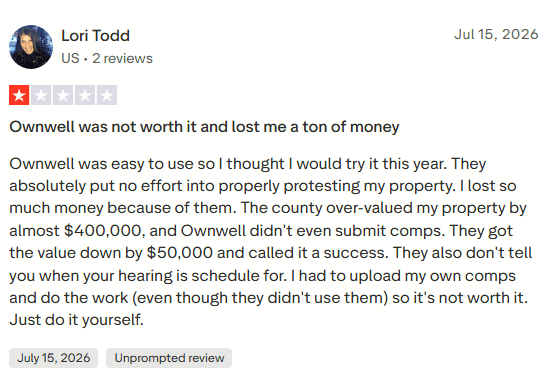
Ownwell was not worth it and lost me a ton of money
“They absolutely put no effort into properly protesting my property. I lost so much money because of them. The county over-valued my property by almost $400,000, and Ownwell didn’t even submit comps. … Just do it yourself.”
★☆☆☆☆
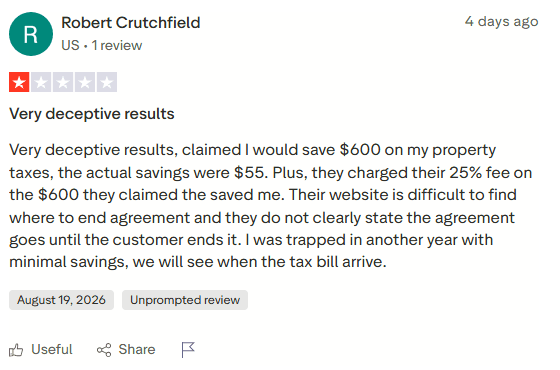
Very deceptive results
“Very deceptive results, claimed I would save $600 on my property taxes, the actual savings were $55. Plus, they charged their 25% fee on the $600 they claimed the saved me.”
★☆☆☆☆
Absolutely unacceptable
“Then I discovered that my appeal had been withdrawn. … One of the worst professional-service experiences I have ever had.”
And the reviews AppealDesk customers leave on the same platform:
★★★★★
Excellent Professional Property Tax Appeal Service
“I wanted to reach out to Travis at AppealDesk and express my sincere gratitude for your invaluable assistance in preparing my property tax appeal.”
★★★★★
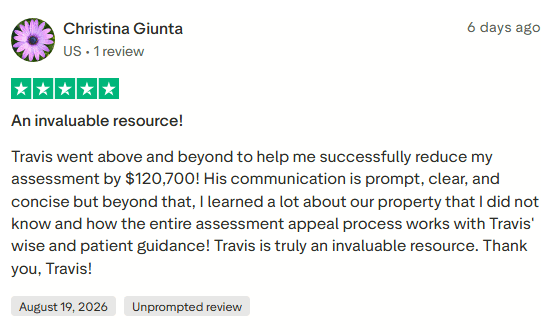
An invaluable resource!
“Travis went above and beyond to help me successfully reduce my assessment by $120,700! His communication is prompt, clear, and concise but beyond that, I learned a lot about our property that I did not know and how the entire assessment appeal process works with Travis' wise and patient guidance! Travis is truly an invaluable resource. Thank you, Travis!”
★★★★★
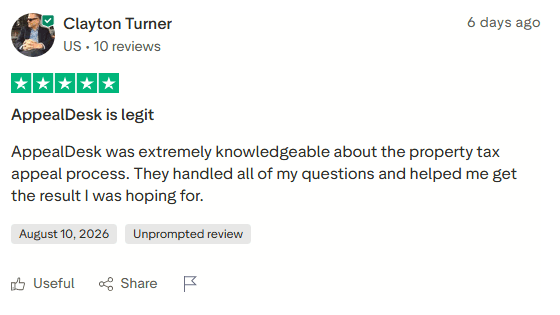
AppealDesk is legit
“AppealDesk was extremely knowledgeable about the property tax appeal process. They handled all of my questions and helped me get the result I was hoping for.”
All excerpts are verbatim from public Trustpilot reviews, read from the live profiles on August 25, 2026. Reviews change over time, so check the profiles directly.
Check If You're Overpaying
Enter your address to see your estimated overassessment and potential savings.
#1: AppealDesk - Best for Budget-Conscious Homeowners
AppealDesk provides an AI-generated evidence packet with comparable sales analysis, assessment ratio verification, property context factors (flood zones, highway proximity, railroad noise), a county-specific filing guide, and a professional cover letter. You pay $49 once and keep 100% of whatever reduction you achieve. The filing guide adapts to your state and county, including the right terminology ("protest" in Texas, "grieve" in New York, "appeal" in most other states), the correct form, and step-by-step filing instructions. Most homeowners complete the filing in 10-15 minutes through their county's online portal. AppealDesk covers all 50 states and over 3,100 counties, making it the only flat-fee option with true nationwide coverage.
Pros
- +$49 flat fee -- the lowest price among paid services
- +All 50 states and 3,100+ counties
- +Includes assessment ratio analysis and property context factors
- +Instant delivery (minutes after purchase)
- +Keep 100% of your savings
Cons
- –You file the appeal yourself (10-15 minutes with the filing guide)
- –No hearing representation -- you attend any hearings with prepared evidence
#2: Ownwell - Best for Zero-Effort Appeals
Ownwell handles the entire property tax appeal process for you: filing, informal hearings, and formal board proceedings. You sign up, provide your address, and they do everything else. Their contingency model means you pay nothing upfront and nothing if they do not achieve a reduction. Their own pricing page states the fee varies by region rather than quoting one national rate, and uses 25% only as an illustration, so check the rate for your specific county before signing. They cite average annual savings of $774 for customers who win a reduction. The trade-off is cost and coverage. At a 25% rate a $3,000 annual reduction sends about $750 to Ownwell, and a higher regional rate sends more. As of August 2026 they operate in 9 states: California, Colorado, Florida, Georgia, Illinois, New York, Pennsylvania, Texas, and Washington, with Pennsylvania limited to Allegheny and Philadelphia counties.
Pros
- +Zero effort -- they handle everything from filing to hearings
- +No fee if they do not save you money
- +Homepage reports an 88% success rate and $774 average annual savings, footnoted as customers who received a reduction on at least one appeal in 2025
Cons
- –Only 9 states covered
- –Rate varies by region and is not quoted as a single national number, so your cost depends on where you live
- –A contingency fee scales with your win: the bigger the reduction, the bigger the bill
- –You do not see or learn from the evidence used in your appeal
#3: O'Connor & Associates - Best for High-Value and Commercial Properties
O'Connor (also known as "Cut My Taxes") is one of the longest-operating firms in the industry and runs a Property Tax Protection Program with in-house appraisal teams and full representation including hearing attendance. Their own program page states that clients pay half of their first year property tax savings, which is the highest fee in this roundup: a $3,000 annual reduction means about $1,500 to O'Connor. They publish $213 million in client savings for 2025. Read the coverage claim carefully, because the 45-state figure on their site applies to commercial property, while their residential offices are concentrated in Texas, Georgia, Illinois and New York. They are strongest on high-value residential and commercial properties where institutional knowledge and arbitration experience matter.
Pros
- +Long-established firm with in-house appraisers and hearing representation
- +Publishes $213 million in client savings for 2025
- +Strong commercial and high-value residential expertise, including binding arbitration
Cons
- –Half of your first-year savings is the highest fee in this comparison
- –The 45-state figure is commercial; residential coverage is far narrower
- –Process can take weeks to months
See detailed AppealDesk vs O'Connor & Associates comparison →
#4: NTPTS - Best for DFW Full-Service Protests
North Texas Property Tax Services specializes exclusively in the DFW metro, covering Dallas, Collin, Denton and Tarrant counties. They work on a 40% contingency, so a $3,000 reduction costs about $1,200. Their deep relationships with local appraisal districts and ARB panels make them a credible choice for DFW homeowners with higher-value properties, and that regional focus is the whole point: they are not trying to cover 50 states.
Pros
- +Deep DFW-specific expertise with local ARB relationships
- +Publishes its 40% contingency rate openly
- +Full-service including ARB hearing representation
Cons
- –Four counties only -- no coverage outside DFW
- –Focused on higher-value homes -- may not serve lower-value properties
- –40% of your savings adds up fast on a large reduction
#5: Texas Protax - Best for Austin and Houston Homeowners
Texas Protax provides full-service protest representation out of Austin and Houston, including automatic annual filing, informal hearing attendance, and ARB representation, with former appraisal district staff and licensed appraisers on the team. Their published residential fee is 40% of actual tax dollar savings with a $50 per parcel minimum, so a small reduction can still carry a floor charge. For properties with a capped market value or special-use valuation they take the greater of the minimum, the savings fee, or $2.50 per $1,000 of market value reduction, which means a charge is possible even when your actual tax bill does not move.
Pros
- +38 years of Austin/Houston protest experience
- +Full-service with automatic annual renewals
- +Former appraisal district staff on the team
Cons
- –40% contingency is among the highest in the industry
- –Austin and Houston only -- no Dallas, San Antonio, or other metros
- –Market value reduction fee can apply even with zero tax savings
- –Auto-renewing contract requires written cancellation
#6: AppealSeal - Alternative Flat-Fee Option
AppealSeal provides a flat-fee DIY evidence tool specifically built for California Proposition 8 decline-in-value appeals. At $100, it costs double what AppealDesk charges for a more comprehensive packet. AppealSeal includes comparable sales with adjustments, a neighborhood map, and market value estimate. It lacks assessment ratio analysis, property context factors, and a cover letter. A reasonable option for California homeowners who want a Prop 8-focused tool, but AppealDesk provides better value for the same DIY approach.
Pros
- +Flat-fee pricing (no percentage of savings)
- +Built specifically for California Prop 8 appeals
- +Free initial property check before payment
Cons
- –California only -- no coverage in any other state
- –$100 is double AppealDesk's $49 for a similar approach
- –No assessment ratio analysis or property context factors
- –No cover letter or structured filing guide
#7: DIY (No Service) - Best for Zero Budget
You can appeal your property taxes entirely on your own at no cost. Research comparable sales through your county assessor's website, Zillow, and public records. Calculate your assessment ratio using recent sales data. File your appeal through your county's online portal, by mail, or in person. The national average success rate for property tax appeals is 40-60%, so even imperfect cases frequently succeed. The trade-off is time: expect 15-40 hours of research to prepare a competitive case.
Pros
- +Completely free
- +Available everywhere
- +You learn the process for future years
Cons
- –15-40 hours of research time required
- –Risk of using non-comparable sales or missing key data
- –No professional formatting for evidence presentation
- –Easy to miss assessment ratio analysis and context factors
All Services at a Glance
| Service | Price | Model | Coverage | Best For |
|---|---|---|---|---|
| AppealDesk | $49 flat | DIY + evidence | All 50 states | Budget-conscious, any state |
| Ownwell | Contingency, varies by region | Full-service | 9 states | Zero-effort, supported states |
| O'Connor | Half of first-year savings | Full-service | 45 states commercial; TX/GA/IL/NY residential | High-value/commercial |
| NTPTS | Standard 40% of savings; special fees may apply | Full-service | Dallas/Collin/Denton/Tarrant | DFW full-service |
| Texas Protax | 40% of savings ($50/parcel min) | Full-service | Austin/Houston | Austin/Houston homeowners |
| AppealSeal | $100 flat | DIY tool | California only | California Prop 8 appeals |
| DIY | Free | Self-research | Anywhere | Time-rich, zero budget |
How to Choose the Right Service
Start with your budget. If you want the lowest cost with professional evidence, AppealDesk at $49 is the clear choice. If money is no object and you want zero effort, Ownwell (9 states) or O'Connor (40+ states) handle everything. Next, check your state. If you are outside Ownwell's 9 states, your full-service options narrow to O'Connor or a local firm. AppealDesk works everywhere. Then consider your effort preference. Are 10-15 minutes of filing worth saving hundreds or thousands in fees? Most homeowners who try AppealDesk's filing guide find it straightforward. If you absolutely refuse to file anything yourself, a full-service option is the way to go. Finally, consider your property. Standard residential overvaluation appeals work well with any service on this list. Commercial properties, assessment methodology disputes, or multi-year corrections may benefit from O'Connor's institutional expertise or a property tax attorney.
Free tools to help you decide
Try our free savings calculator to check if you're overassessed before choosing a service.
Once you're ready, our appeal checklist walks you through every step.
Related Resources
Explore by Location
Ready to See If You're Overpaying?
Enter your address to see your estimated overassessment and potential savings.
Frequently Asked Questions
What is the cheapest property tax appeal service?
Are property tax appeal services worth it?
What is the difference between flat-fee and contingency services?
Can I appeal my property taxes myself?
Which property tax appeal service works in my state?
How much can I save on property taxes?
Do I need a lawyer to appeal my property taxes?
Who are the best property tax protest companies in Texas?
Which service has the best success rate?
Burned by another service this year?
If a property tax service dropped your appeal, missed your deadline, or stopped answering, we'll build your packet free. Email support@appealdesk.com with your address and what happened. We think every homeowner deserves a real shot at their appeal.